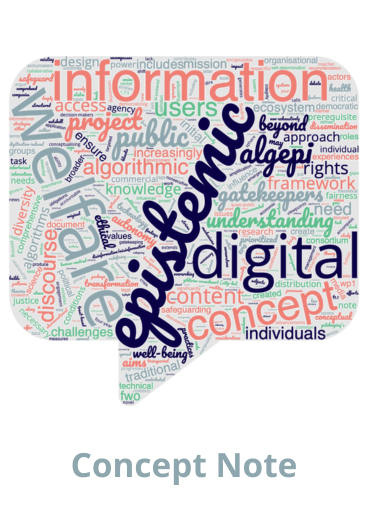
Epistemic Welfare: Dissecting a novel concept

March 13, 2024

This publication is a concept note stemming from Work Package 1 (WP1) led by the KU Leuven Center for IT and IP Law and synthesizes the efforts of all consortium partners aimed at developing normative theories underpinning Epistemic Welfare. Building upon the Glossary of Key Terms, the document encapsulates Task 1.1’s findings, presenting a cohesive conceptual framework for Epistemic Welfare.

Structured to offer a comprehensive overview, the concept note underscores the critical need to comprehend and navigate the evolving digital landscape. ALGEPI’s mission extends beyond fostering discussions on Epistemic Welfare; it seeks to pioneer measures of ‘epistemic welfare by design’ to safeguard digital users’ rights and well-being.

At its core, the concept of “Epistemic Welfare” emerges as pivotal in understanding knowledge interaction within today’s digital society, transcending mere access to information to empower individuals and communities in knowledge production and dissemination, thereby shaping our collective understanding.

As it progresses beyond its initial year, the ALGEPI Project refines its theoretical approach, analyses interactions among digital actors, and identifies the conditions that either facilitate or obstruct Epistemic Welfare. Its objective is to formulate practical strategies and guidelines, based on thorough legal and policy analysis, to ensure algorithmic systems promote Epistemic Welfare.

Other resources

Cultures of quantification and quantification of culture: The effects of quantifying literary practices on users of digital platforms

Cultures of quantification and quantification of culture: The effects of quantifying literary practices on users of digital platforms

Author: Juliette Parmentier | Centre de Recherche en Information et Communication (ReSIC) and Namur Digital Institute (NADI) DOI: 10.4000/15boa Abstract Despite the extensive body of ...
Epistemic welfare and public service media’s algorithmic recommender systems: A theoretical framework, operationalization and relevance for governance

Epistemic welfare and public service media’s algorithmic recommender systems: A theoretical framework, operationalization and relevance for governance

Authors: Hilde Van den Bulck |Department of Communication, Drexel University, Philadelphia (United States) Michelle Kulig | Department of Communication and Media Research, University of ...
Exploring Freedom of Thought: Emine Ozge Yildirim Vranckaert at the Minds, Freedoms, and Rights Conference

Exploring Freedom of Thought: Emine Ozge Yildirim Vranckaert at the Minds, Freedoms, and Rights Conference

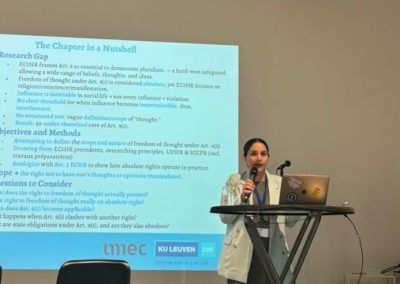
On 31 October, Emine Ozge Yildirim Vranckaert, researcher within the ALGEPI project, presented her forthcoming book chapter titled “The Mind and the Law: A Contextualized Framework for Freedom ...