Untouched minds in a tangled web: navigating mental autonomy and epistemic welfare amidst digital propaganda

July 25, 2025

Author:

Emine Ozge Yildirim-Vranckaert | Centre for IT & IP Law, Faculty of Law and Criminology, KU Leuven, Leuven, Belgium

Aaron Hyzen | Media, Inequality & Change Center, Annenberg School for Communication, University of Pennsylvania, Philadelphia, PA, United States

DOI: 10.3389/fcomm.2025.1562368

Abstract

In this article, we propose a new theoretical account of mental autonomy through which policymakers can develop new legal instruments to mitigate the harms caused by propaganda. We argue for a renewed understanding of mental autonomy, informed by relational autonomy, highlighting its interdependent nature, shaped by technological mediation and social structures in the digital public sphere. We begin by defining propaganda and discussing its potential to inflict harm through the transformational forces of datafication, algorithmization, and plaformization. A historical review of legal approaches to propaganda reveals critical gaps in existing frameworks, which continue to rely on outdated perceptions of autonomy that assume the mind is largely immune to external influences. To address these inadequacies, we build upon the novel concept of epistemic welfare—societal structures and conditions to ensure epistemic agency—and extend it to mental autonomy, which we argue is a necessary precursor to such welfare. Finally, while recognizing the challenges of implementing legal protections against propaganda, we advocate for a governance approach that balances protection and freedom within the broader notions of free thought and expression.


Other resources

Cultures of quantification and quantification of culture: The effects of quantifying literary practices on users of digital platforms

Cultures of quantification and quantification of culture: The effects of quantifying literary practices on users of digital platforms

Author: Juliette Parmentier | Centre de Recherche en Information et Communication (ReSIC) and Namur Digital Institute (NADI) DOI: 10.4000/15boa Abstract Despite the extensive body of ...
Epistemic welfare and public service media’s algorithmic recommender systems: A theoretical framework, operationalization and relevance for governance

Epistemic welfare and public service media’s algorithmic recommender systems: A theoretical framework, operationalization and relevance for governance

Authors: Hilde Van den Bulck |Department of Communication, Drexel University, Philadelphia (United States) Michelle Kulig | Department of Communication and Media Research, University of ...
Exploring Freedom of Thought: Emine Ozge Yildirim Vranckaert at the Minds, Freedoms, and Rights Conference

Exploring Freedom of Thought: Emine Ozge Yildirim Vranckaert at the Minds, Freedoms, and Rights Conference

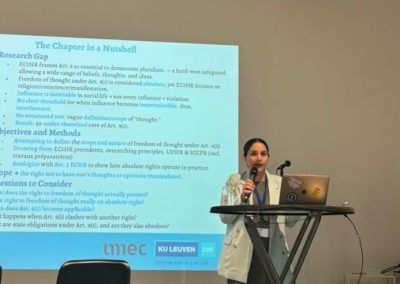
On 31 October, Emine Ozge Yildirim Vranckaert, researcher within the ALGEPI project, presented her forthcoming book chapter titled “The Mind and the Law: A Contextualized Framework for Freedom ...