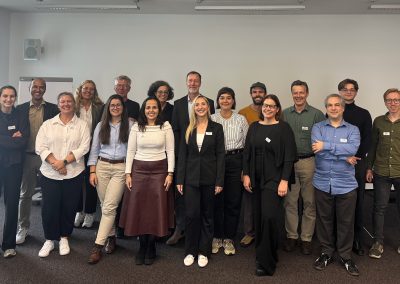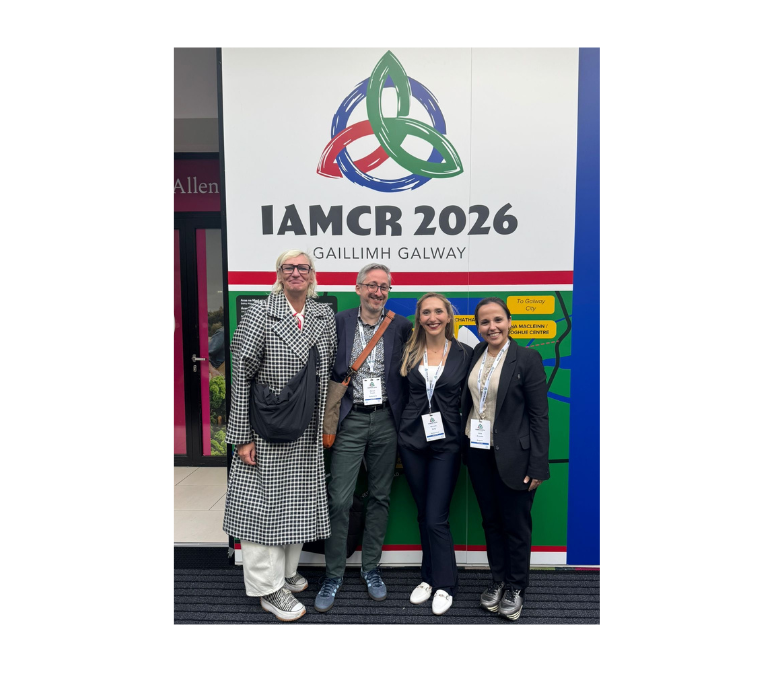
A team of ALGEPI researchers took part in the 2026 conference of the International Association for Media and Communication Research (IAMCR) hosted by the University of Galway, Ireland, from 28 June to 2 July 2026. The conference theme, “Peripheries and Connections: Media, Communication, and Transformation”, invited participants to reflect on how contemporary media systems are being reshaped by digital transformation, platformisation, inequality, and changing forms of communication.
ALGEPI researchers and collaborators contributed to these debates through three presentations addressing algorithmic recommender systems, news avoidance, and the regulation of AI in European newsrooms.
Hilde van den Bulck, from Drexel University, and Manuel Puppis, from the University of Fribourg, presented ongoing research on the use of algorithmic recommender systems by news organisations in Belgium and Switzerland. This was a collaborative effort of them both together with Steve Paulussen and Michelle Kulig. Drawing on epistemic welfare, the presentation explored whether and how news organisations use algorithmic systems to personalise news content, which values guide their design, and how editorial, technological, and managerial actors collaborate in their implementation. The research points to persistent tensions around automation, human curation, transparency, user agency, and the role of public service values in recommender design.
Michelle Kulig, from the University of Fribourg, presented work on news avoidance, news deprivation, and audience disengagement in Belgium and Switzerland. The study, carried out by Michelle Kulig, Willem Buyens, Manuel Puppis, Hilde van den Bulck and Steve Paulussen, challenges the tendency to treat all forms of low news consumption as equivalent. Instead, it distinguishes between intentional news avoidance, unintentional news avoidance, and news deprivation. Based on a comparative survey in Switzerland and Belgium, the findings also show that patterns of avoidance do not simply follow national borders, but are strongly shaped by language regions and shared media ecologies. In this sense, the study contributes to a more precise understanding of how audiences navigate dense, demanding, and emotionally burdensome news environments.
Aina Errando, from imec-SMIT, Vrije Universiteit Brussel, also on behalf of Dario Pronesti, Emine Ozge-Yildrim and Aleksandra Kuczerawy, from the KU Leuven Centre for IT & IP Law, and Heritiana Ranaivoson, from imec-SMIT, Vrije Universiteit Brussel, presented research on the governance of AI in European news organisations. Their paper investigates how AI regulatory frameworks are interpreted and operationalised within newsrooms. The paper argues that AI regulation is adapted, negotiated, or sometimes only symbolically integrated depending on organisational culture, professional values, and available resources.
The discussions at IAMCR provided an important opportunity to connect ALGEPI’s work with other scholars working in the same and complementary research fields. Looking forward to seeing all ongoing work published!